Self-Care Especially for Doom Times
Self-care has political roots.
Before it was packaged, Pinterested, and sold back to us, the idea of self-care came from the world of social action. It was articulated most powerfully by Audre Lorde—a Black, queer, feminist writer navigating racism, sexism, homophobia, and cancer—when she wrote:
“I had to examine…the devastating effects of overextension. Overextending myself is not stretching myself. I had to accept how difficult it is to monitor the difference….Caring for myself is not self-indulgence, it is self-preservation, and that is an act of political warfare.”
—A Burst of Light and Other Essays
Lorde understood that she could not count on flawed systems to care for her, or tell her when to slow down. She understood that we are not separate from our communities, and that tending to our own health is one way of sustaining them. If we want to keep doing the work, we have to keep ourselves intact enough to do it.
If self-care is, in part, about staying whole enough to remain engaged, the question becomes: how?
We know the typical answers: manage stress, get good sleep, find time for ourselves. But since Election Day 2024, I’ve consistently prescribed one thing to my clients. It’s simple, evidence-based, and stunningly powerful—
Go find awe.
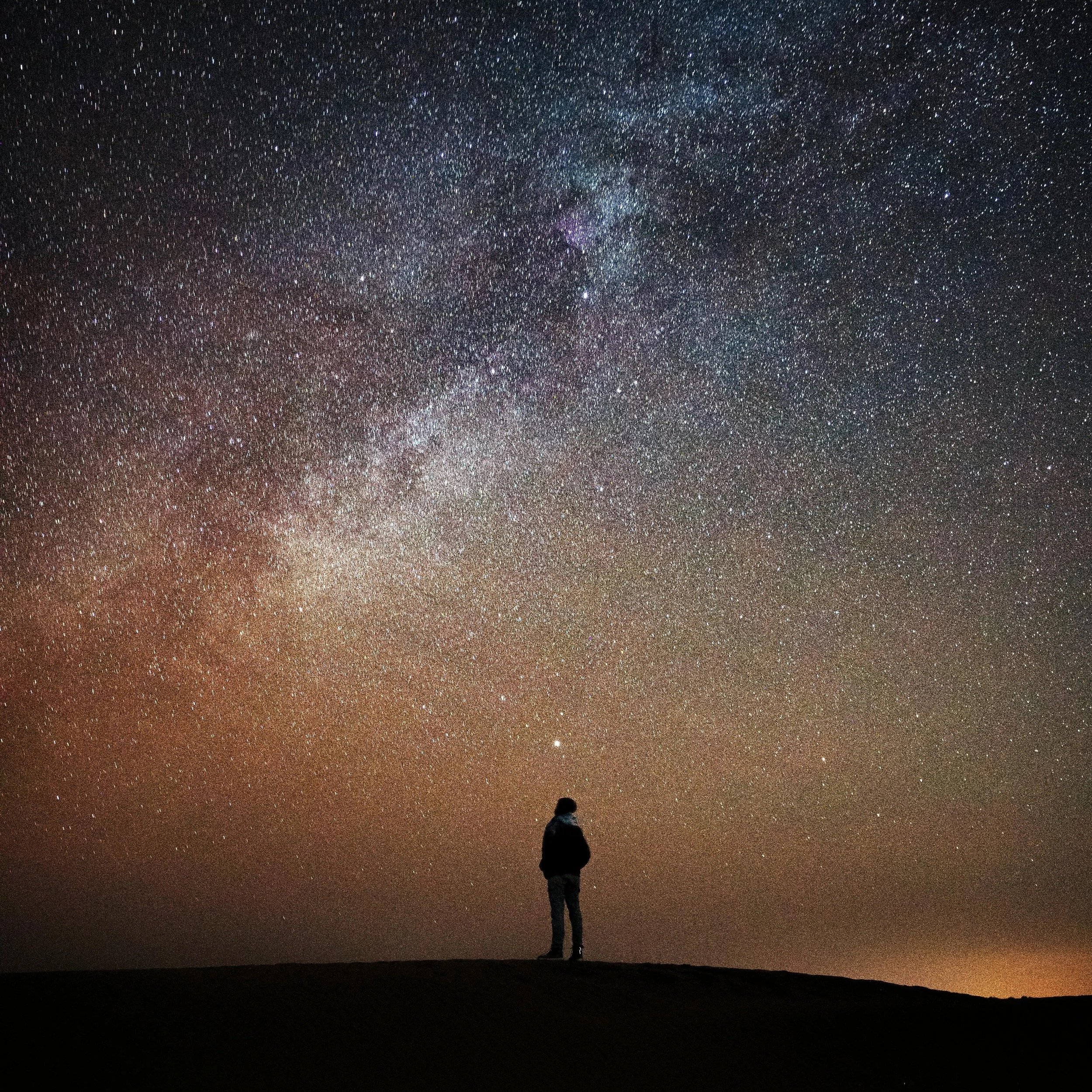
Awe is not rare. It just requires attention.
Photo by Aarin Husain via Pexels.com
What do you mean by awe?
Psychologists define awe as the feeling we experience when we encounter something vast—physically, temporally, intellectually, morally, spiritually—and our current mental framework has to stretch to contain it. It carries hints of gratitude, fear, curiosity, and humility.
For me, awe feels like a slight stomach drop and a gasp in the throat, followed by body-wide release of tension. Other people feel it differently. My son once told me he didn’t feel it like I did and he thought the phrase “It took my breath away” was an exaggeration—until he watched me come undone during a pretty sunset while we were driving.
Awe looks different for everyone, but it has very real impact on the body; it’s a nervous system response to encountering something larger than our understanding.
What awe does for brain & body
There’s strong research—especially from psychologists like Dacher Keltner and Jonah Paquette—showing that awe has measurable effects on our nervous systems.
Awe consistently:
Dampens stress responses
Lowers markers of inflammation in the body
Engages both alertness and calm at the same time (a rare and healing combination)
Increases pro-social behavior—generosity, cooperation, and feelings of connection
Expands our sense of time, so we feel less rushed and frantic
Reduces rumination and self-focus (sometimes called the “small self” effect)
That alone is self-care. Awe is a wonderful stress management tool with immediate benefits. But it does something else important when the world feels like a hopeless mess and you’re treading water, trying not to drown in doom....
Awe is particularly suited for coping with political and climate anxiety. Because many of us—especially the hyper-responsible, big-feeling, perfectionistic types—carry a vague sense that we should be able to fix everything, save everyone, and solve the unsolvable.
Awe lovingly disrupts that illusion.
It reminds us in our bones that we are small parts of a vast and complicated system, and this is all so much bigger than us. Keltner describes this as “cosmic insignificance therapy.” When that perspective shifts, our bodies respond.
We unclench. We rest. We breathe.
Finding awe every day
Our culture tends to treat awe as something for bucket lists, expensive travels, and once-in-a-lifetime spectacles. So we overlook how much wonder is already within reach.
Awe is not rare. It just requires attention. Like love or sleep, it can’t be forced, multitasked, or optimized; we can only create the conditions and show up for it.
Microdosing Awe (5 minutes or less)
Look up. Notice cloud formations, flying birds, sunsets, stars, treetops, architecture.
Look down. Pay close attention to something tiny until you learn something new about it: an insect, a rock, a leaf.
Find a song that’s moved you in the past. Listen to the whole thing, loud, with your eyes closed.
Immersive Awe
Take an awe walk.
Go feel small next to something vast. Find a great view. Maybe you live near an ocean, mountain, or big city. Everyone lives near the sky.
Visit a museum or historical site of someone or something you admire: great artists, moral leaders, nature’s power.
Spend time at the edges of life. Hold a newborn. Visit a cemetery. Life’s bookends are fertile ground.
Shared Awe
Participate in something communal. Go line dancing, perform in a church choir, sing along at a concert.
Spend time with noticers: people who notice and find wonder in just about everything. Children are especially good at this.
Share awe stories. Ask someone to tell you about a time they were deeply moved. (Note on this below***)
The next time you feel the doom spiral starting—when the news feels suffocating or you feel overburdened and hyperextended—just try it. Go find awe. Step outside. Look up. Notice something vast or intricate or beautiful. Give it your full attention for a few minutes, and see what happens.
This kind of self-care is the opposite of burning out, tuning out, and numbing out. Awe restores perspective and keeps us whole, human, and capable of staying in the work.
And if you’d rather not do it alone, I’ll be creating a few shared spaces soon—a running group for recovering perfectionists, and a ***free evening devoted entirely to sharing awe stories. More on this soon.
For now: go find awe.
This is part four in a five part series, "How Not to Drown in Doom Right Now."
Part 1: "You can't care about everything"
Part 2: Our relationship to the news
Part 3: Imperfect Activism: "But what can I actually do?"
The final part next week will be on maintaining relationships when loved ones have very different values than we do. After that, I will resume writing on perfectionism.
© 2025–2026 Summer Hopkins Myers | Already Good
This work is original and protected. Sharing links is welcome; unattributed reproduction and LLM training is not.