Weaponized Gratitude
“I should be thankful.”
“Other people have it way worse!”
“But I should focus on all the things that are going well in my life…”
I can’t tell you how many times I hear my clients say things (I’m an anti-perfectionism coach and therapist) just like this.
And listen, I love a good perspective shift. I’ll always cheer for the humble acknowledgement of our gifts and privileges. But I don’t think that’s what we’re doing when we say these things; underneath these ostensibly grateful words, I think the real message is:
“Something here is bothering me, but I feel guilty for having feelings about it.”
What a tidy way to dismiss our own emotions: it’s guilt disguised as gratitude, self-invalidation dressed up as virtue. And our culture teaches it to us young. You probably heard some version of these phrases growing up: “Finish your dinner, kids are starving somewhere,” or “Buck up, you don’t know how good you have it.” These were rarely lessons in compassion or global awareness. They were containment tactics for inconvenient emotions. We heard the real message beneath them: “Your needs don’t matter because there are bigger needs out there.” “Don’t trust your own disappointment and frustration.” “Nobody wants to hear this.”
By adulthood, this voice becomes our own. We try and shame ourselves out of the unacceptable feeling—anger, say, or loneliness—and into a virtuous one called thankfulness. The self-invalidation is already painful, but I think the hidden tragedy here is how this pattern warps our relationship to genuine gratitude.
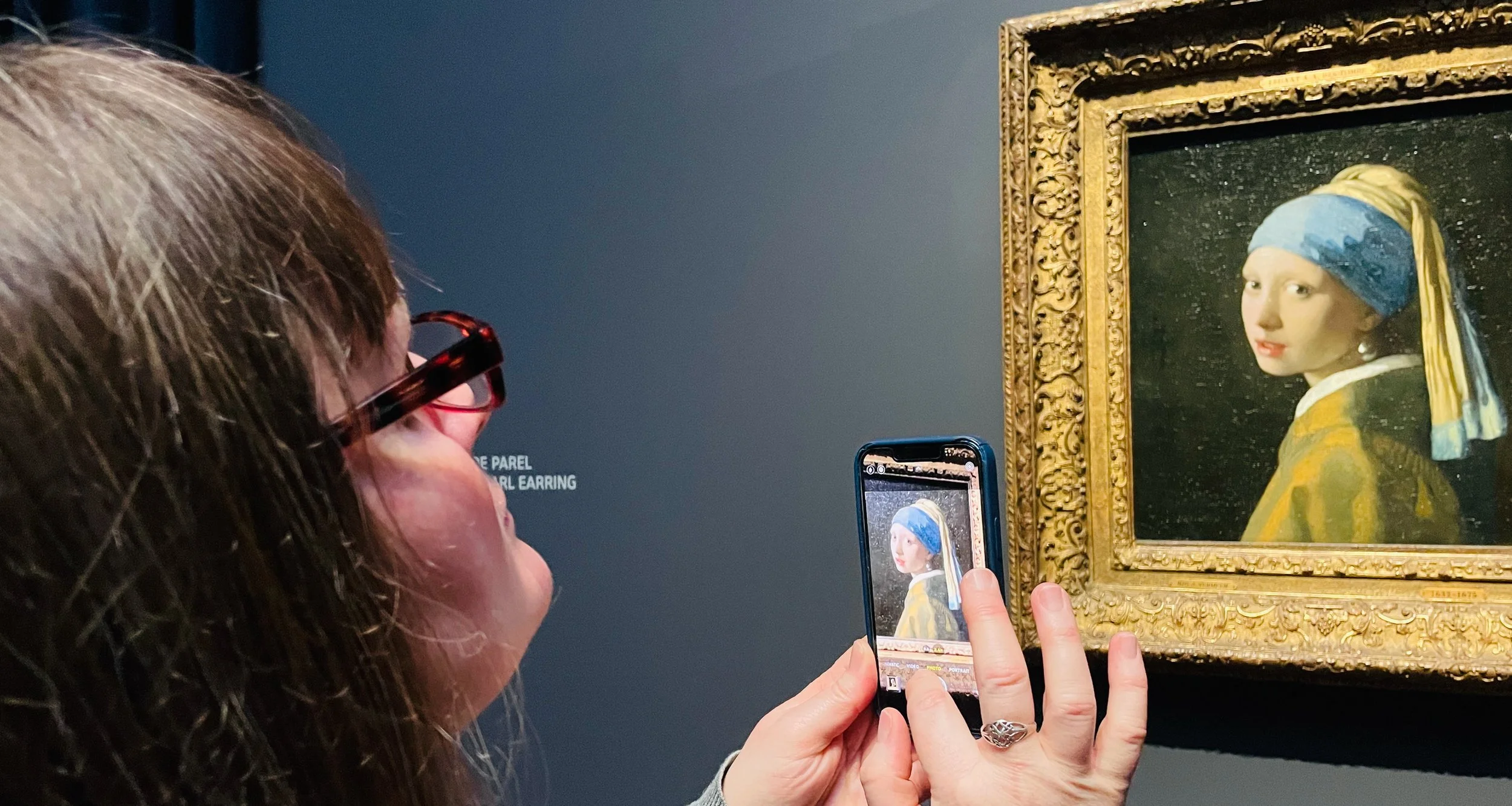
A pale facsimile stealing the spotlight from the real thing during my 2023 Vermeer visit with a dear friend. (Shared with her blessing, and with affection for the metaphor.)
Genuine gratitude is not timid. In its purest form, gratitude is an expansive and trembling thing. It doesn’t police our negative emotions or fit itself neatly into three lines in a five-year journal, or a once-a-year holiday. Medical-grade gratitude opens our eyes wide and leaves us on our knees. I wish I knew a bullet-proof way to access this kind of genuine gratitude at will, but I suspect it doesn’t work like that. I suspect that, like falling asleep or falling in love, it can’t be forced, and the best we can do is prepare our surroundings and ourselves to receive it.
I could be wrong about that, of course, and I want to hear your thoughts. But later this week—the official week of thankfulness in the States—I’ll share ways that we can open ourselves up and invite more genuine gratitude into our lives.
© 2025–2026 Summer Hopkins Myers | Already Good
This work is original and protected. Sharing links is welcome; unattributed reproduction and LLM training is not.